The Invisible Experience: What Children of Defenders Feel — Results of the First All-Ukrainian Study

More than half of children from families of veterans and military personnel in Ukraine live in a state of fear or tension. Adolescence in the context of war is marked not only by emotional difficulties, but also by serious changes in behaviour and social interactions, shifts in values, and transformations in family relationships. At the same time, the support system often fails to meet the genuine needs of these children, leaving them without adequate protection and understanding.
About the Study
“I missed him very much, sometimes I cried a lot in my room. I just hid under the blanket and cried” — child, age 11
This is just one of many quotes conveying the real emotions of children whose parents are defending the country. To better understand their experiences, the NGO “Vilnyy Vybir” initiated and conducted the first all-Ukrainian study dedicated to the emotional, behavioural, and social characteristics of children of defenders.
Adolescence in the context of war is marked not only by emotional difficulties, but also by serious changes in behaviour and social interactions. Children become more cautious, often withdrawn or, conversely, display heightened aggression, reflecting their internal experiences. Their values shift: there is a growing desire for safety, justice, and support from loved ones. Family relationships also transform — children re-evaluate parental care, the role of elders, and the importance of mutual support within the family.
The aim of the study was a systematic examination of the psychological state, social needs, and value well-being of children aged 10–16 from families of veterans and military personnel, as well as the development of recommendations for improving support policies.
The study included two groups of participants — children and their parents or guardians — and was based on the analysis of adult–child pairs, which allowed for a deeper understanding of family dynamics, emotional experiences, needs, and children’s values.
Based on the study’s findings, specialists compiled the guide “Needs of Children in Families of Veterans and Military Personnel,” which systematises key analytical findings and formulates conclusions and recommendations.
Authors
The study was conducted by the NGO “Vilnyy Vybir” with the support of the NGO “Voices of Children” and in collaboration with the Fama agency, combining expert knowledge and practical experience in working with children and families.
Methodology
A mixed-methods approach was applied:
- quantitative stage — online survey;
- qualitative stage — in-depth interviews.
The questionnaire consisted of two parts: for parents and for children.
Sample
Quantitative stage:
Target — 1,500 respondents (750 families)
Actual — 2,504 respondents (1,252 families)
Qualitative stage:
40 families (80 respondents)
Psycho-emotional State of Adolescents: How Children Live with Constant Anxiety
The study results reveal a high level of emotional burden among children of military personnel:
- 55% of children constantly experience fear or sadness due to a parent’s service; a further 24% experience such emotions periodically;
- 53.2% of children are in a state of heightened tension, indicating a high level of distress; this state may last several days or remain constant;
- 48% avoid news and conversations about the war;
- 97% of adolescents have at least one trusted person they can confide in; when it comes to direct emotional support within the family, the figure is 87%.

A Dual Crisis: Adolescence During Wartime
Adolescence inherently involves a process of separation from parents and the gradual acquisition of autonomy.
In the context of war, this natural process is complicated by the constant fear of losing loved ones and the dangers surrounding the child.
An adolescent simultaneously:
- seeks autonomy
- needs safety and adult support
The brain operates in an overloaded state: the emotional system is active, while self-regulation mechanisms are not yet fully developed. This leads to:
- emotional outbursts,
- impulsivity,
- withdrawal and avoidance of contact.
Conclusion:
An adolescent constantly balances between the desire to separate and the fear of being left without support, making their emotional world particularly vulnerable in times of war.
Fear as a New Reality
Children’s fear has two main components:
- external — for the life of a parent
- internal — related to shelling
The familiar premise “father left — he will return” transforms into: “he may not return.”
Conclusion:
For these children, war is not news — it is their daily reality.
Digital Closeness Instead of Physical Presence
Due to the absence of one parent, relationships shift to a digital format:
- phone calls
- video calls
- online rituals
This helps maintain emotional connection, but does not replace physical presence.
Forced Maturation
Children frequently take on responsibilities and obligations typically fulfilled by the absent parent:
- they become the “head” of the family
- they attempt to control the situation
This provides a sense of strength, but:
- deprives them of the right to vulnerability
- accelerates maturation
“Military” and “Civilian” Childhood
Children from military families frequently encounter unique difficulties in communication and social interaction.
- they cannot always share their experience with peers
- they avoid sympathy
- they seek to live a “normal” childhood
Conclusion:
These children need not pity, but respect for their experiences and space to simply be ordinary children.
School: Between Support and Limitations
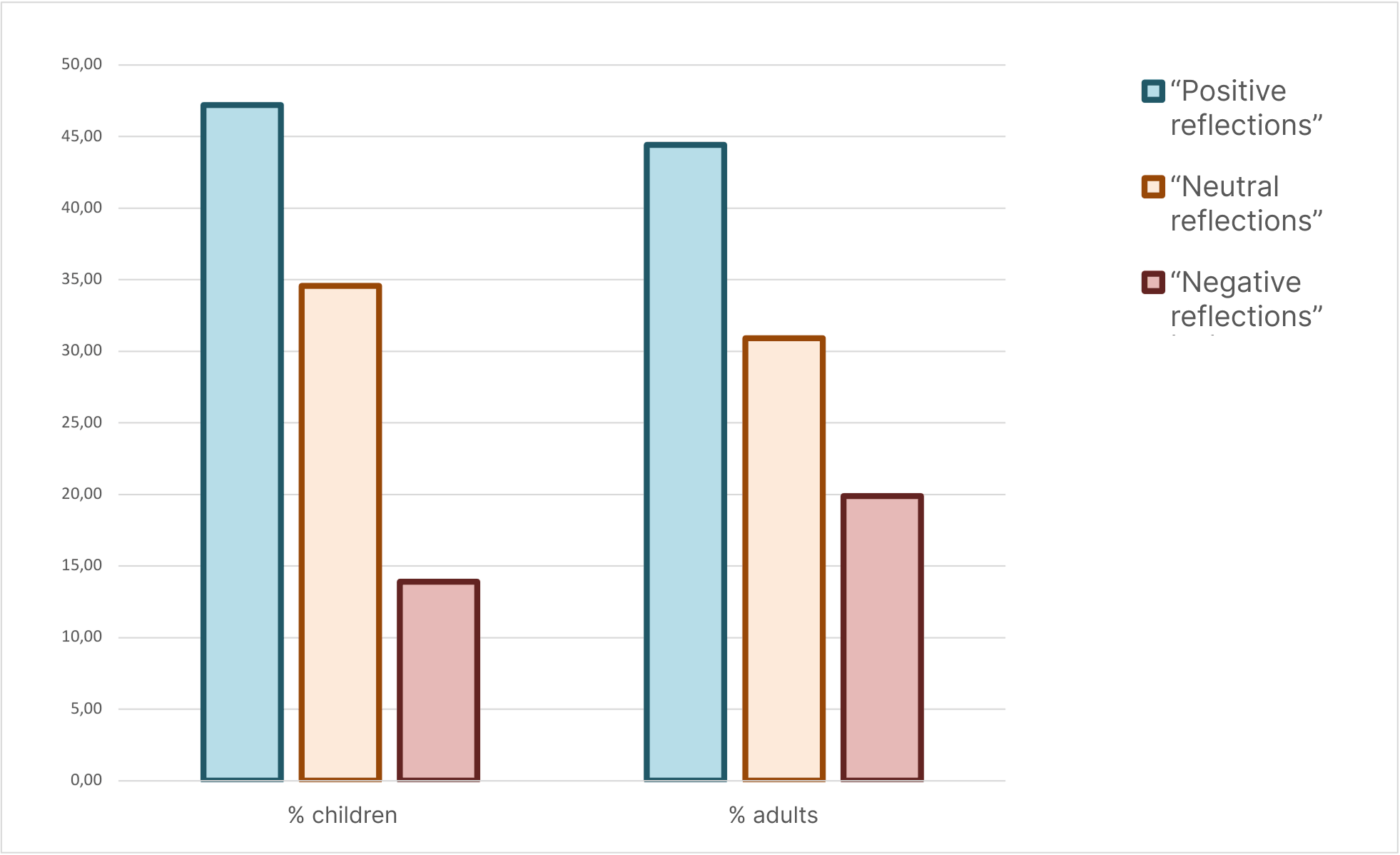
School remains an important environment for socialisation, yet the level of satisfaction does not exceed 50%.
Key tendencies:
- children assess their experience more positively than parents
- adults tend to explain the negative
- children are more optimistic
Sense of Community
- 84% of children and 86% of adults note that the child feels part of the school community;
- yet only 45% of respondents note that this positively affects the child’s self-esteem.
Distance Learning: Lost Motivation
The study identified three main groups of children based on their learning experience:
- Children who returned to in-person learning — more motivated.
- Those who did not adapt to the online format — often experience a decline in academic results and lose interest in subjects.
- Children who studied remotely for a long period — maintain motivation only for individual subjects that interest them or to which they are oriented.
- Additionally: a mixed format disrupts daily routines.
Social Services: Accessibility and Barriers
Positive experiences are noted in interactions with:
- civil society organisations
- volunteers
At the same time:
- some do not access social services due to bureaucracy
- or due to unawareness of their existence
Values: A Focus on Survival
The strongest needs identified:
- safety — 98%
- benevolence — 98.9%
- emotional relief — 97.7%
In contrast:
- achievement — only 64.5%
This reflects a reorientation from development to survival.
Identity and Stigmatisation
Despite 86.7% expressing pride in their parents:
- 42.7% of children wish to conceal the fact of their service
This signals:
- stigmatisation
- an environment unprepared for ecologically sound communication about war
The Communication Gap in Families
Comparing children’s and parents’ responses reveals:
- parents understand their children’s basic characteristics
- but underestimate their children’s internal state
This creates:
- distance
- a lack of trust
General Conclusion
The study records a systemic shift towards basic survival:
- fear becomes a background state
- resources are spent on self-regulation
- children mature more rapidly
- social strategies change
At the same time, an ambivalent attitude towards society is forming:
- disillusionment with institutions
- strong solidarity with the military
What This Means for the Support System
The findings point to the need for:
- programmes for the entire family, not only for children
- development of trusting communication
- creation of safe environments in schools
- reduction of stigmatization
- improved access to services